The story — Jardin Majorelle
The Jardin Majorelle is not just a green space in the Guéliz district — it is a living painting composed over four decades. French painter Jacques Majorelle, son of the renowned Art Nouveau cabinet-maker Louis Majorelle from Nancy, arrived in Marrakech in 1917 in search of light and warmth, fell for the city and decided to stay.
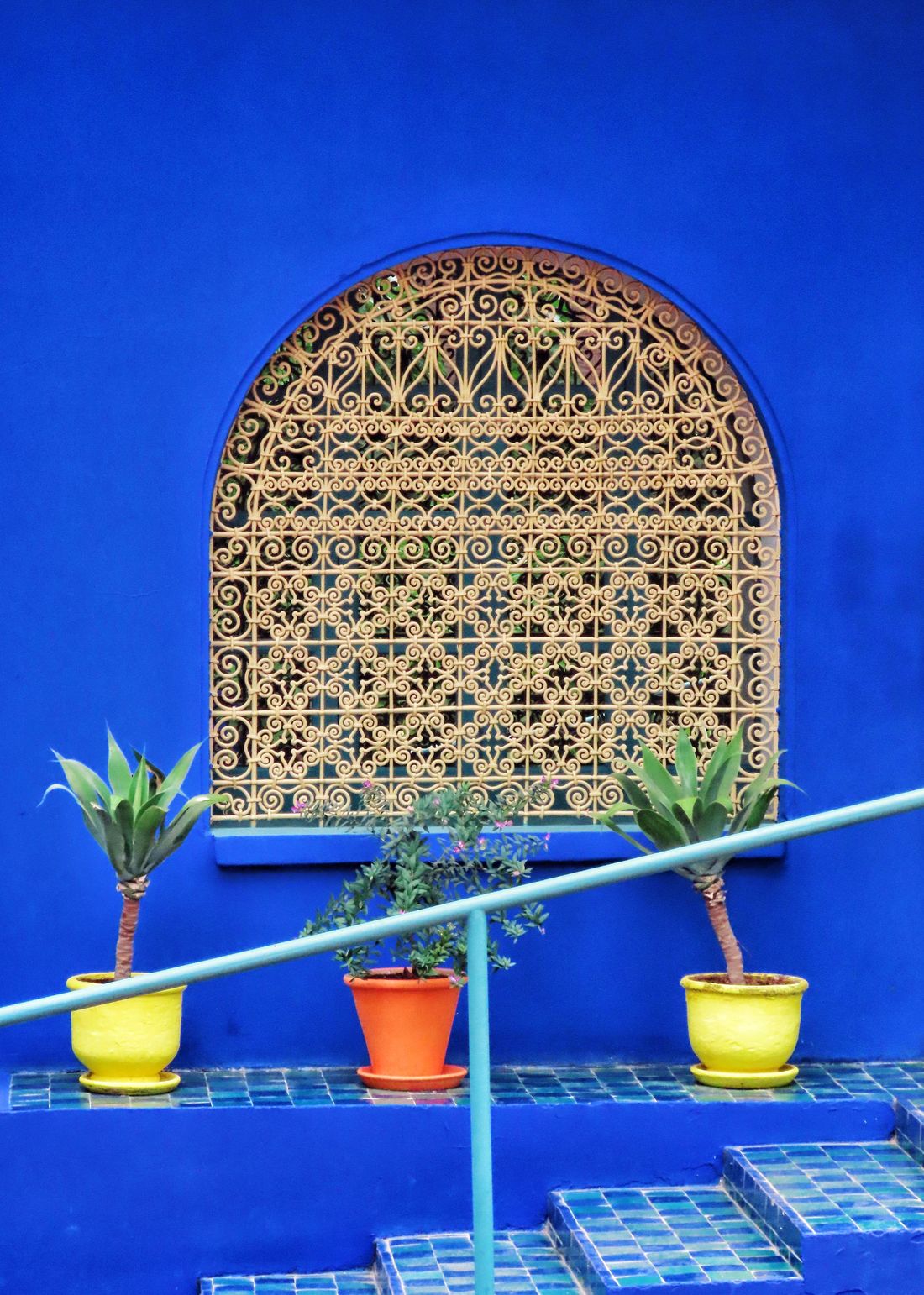
In 1923 he bought a plot at the edge of the palm grove and began planting species brought back from his travels: cacti from the Americas, bamboo from Asia, palms, water lilies and fragrant plants. In 1931 the architect Paul Sinoir built him a modernist studio, which Majorelle painted in an intense cobalt shade now known worldwide as “Majorelle Blue”.
Majorelle opened the garden to the public in 1947, but its upkeep weighed heavily on him, and after his death in 1962 it fell into neglect. In 1980 the couturier Yves Saint Laurent and his partner Pierre Bergé discovered it — threatened by a hotel project — bought it and brought it back to life, settling in the neighbouring Villa Oasis.
Today the garden holds around three hundred plant species, shaded paths, pools where fish glimmer, and pots painted yellow, green and blue. In a quiet corner stands a memorial to Yves Saint Laurent, whose ashes were scattered in the rose garden in 2008.
The former studio now houses the Pierre Bergé Museum of Berber Arts, and the site is run by the Fondation Jardin Majorelle, a non-profit foundation that reinvests its income in cultural, educational and social projects in Morocco. It is the natural first stop on any tour of the museums of Marrakech, and one of the best cultural sites in Morocco.
Don’t miss
- The blue villa and Jacques Majorelle’s studio (1931)
- The cactus garden and its rare shapes
- The Yves Saint Laurent memorial
- The Pierre Bergé Museum of Berber Arts inside the garden
Photos
Some photos are illustrative.